
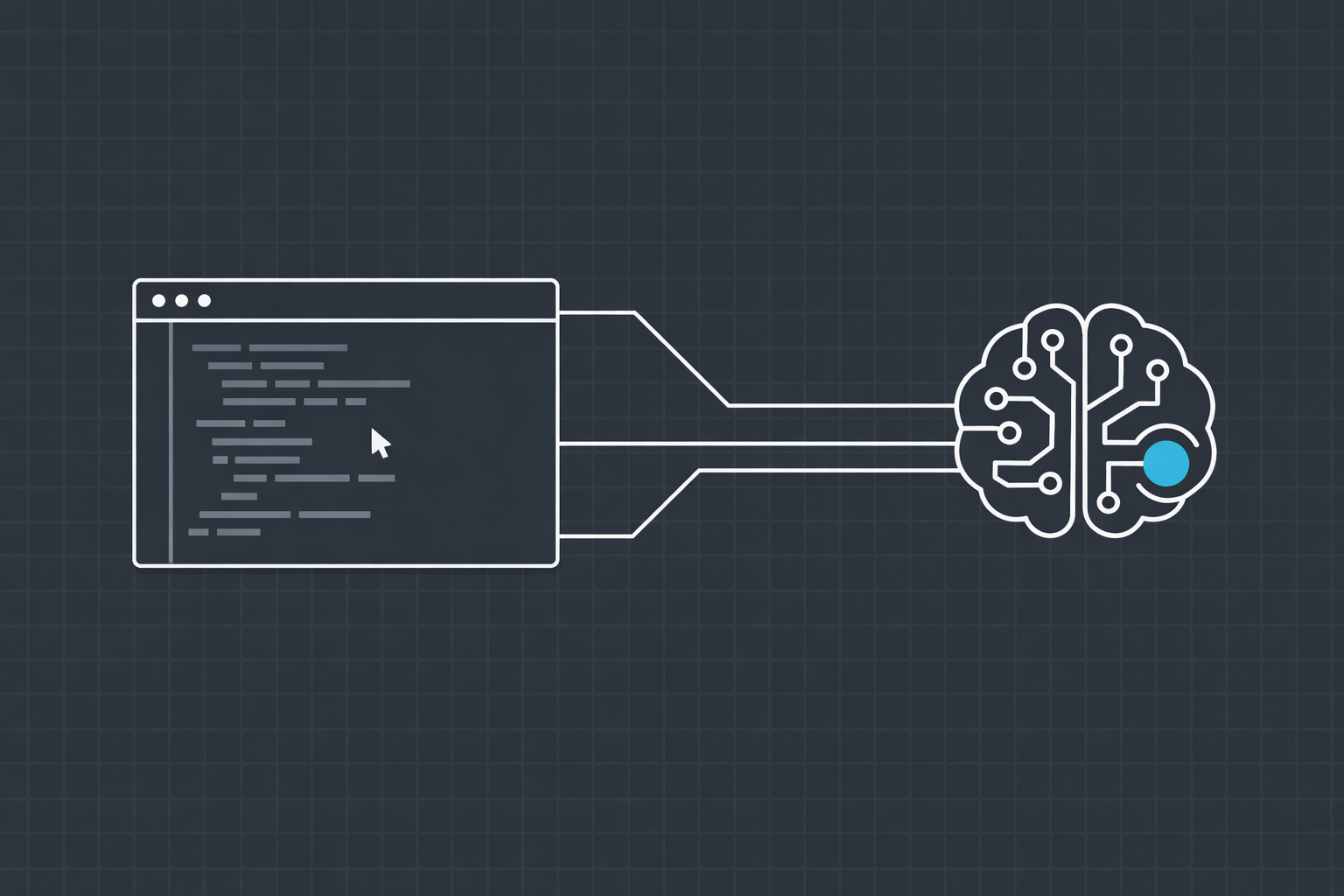
Every few months, someone sends me an article claiming AI is about to replace software developers. The headlines have been running for years now, and I understand why they get attention. The tools have genuinely gotten better. I use them every day. But the gap between "AI can write code" and "AI can build software" is enormous, and most of the conversation around AI in development misses that distinction entirely.
I want to give you an honest, practitioner-level take on where things actually stand. Not the venture capital pitch. Not the doomsday prediction. Just what I have seen working with these tools on real client projects over the past couple of years, what has changed about how we work, and what has not changed at all.
If you are a business leader trying to understand what AI means for your software projects and budgets, or a developer trying to figure out how to use these tools effectively, this is written for you.
What AI Tools Can Reliably Do Today
Let me start with what genuinely works, because there is real value here and ignoring it would be dishonest.
Boilerplate and Scaffolding
AI coding assistants are excellent at generating repetitive, pattern-based code. Setting up a new API endpoint with validation, error handling, and response formatting. Writing the CRUD operations for a new database entity. Scaffolding a React component with props, state management, and basic styling. These are tasks that follow well-established patterns, and AI tools can produce working code for them in seconds instead of the minutes or hours it would take to write by hand.
This is not trivial. A significant chunk of day-to-day development work is exactly this kind of structured, pattern-based coding. When the tool handles the boilerplate, developers spend more time on the parts that actually require thinking.
Code Translation and Migration
Converting code from one language or framework to another is something AI tools do remarkably well. Translating a Python script to TypeScript. Converting a class component to a functional component with hooks. Migrating SQL queries from one dialect to another. The tools understand the syntax and conventions of multiple languages deeply enough to produce reasonable translations that need only minor adjustments.
We have used this on client projects when modernizing legacy systems. Having an AI tool do a first pass at converting old code to a modern framework saves significant time, even though every line still needs human review.
Test Generation
Writing unit tests is one of those tasks that developers know they should do more of but often skip because it feels tedious. AI tools can generate comprehensive test suites from existing code, including edge cases that a human might overlook. The tests are not always perfect, but they are a strong starting point that is far better than having no tests at all.
Documentation and Explanation
AI tools can read existing code and generate clear explanations of what it does, produce API documentation, and write inline comments. This is especially valuable when you are working with legacy codebases where the original developers left no documentation. Having the AI generate a first draft of documentation that you then refine and verify is significantly faster than writing it from scratch.
Where They Fall Short
Here is where the honest conversation starts.
Architecture and Design Decisions
AI tools can write code that works. They cannot tell you whether you should write that code in the first place. Should this be a monolith or microservices? Should you use a relational database or a document store? Should this logic live on the client or the server? These are decisions that require understanding the business context, the team's capabilities, the deployment environment, the expected scale, and the maintenance burden. AI tools have no model for any of this.
I have seen teams use AI to generate entire service architectures that looked impressive on paper but were wildly overengineered for their actual needs. The tool will happily build you a distributed event-driven system with message queues and eventual consistency when what you actually need is a straightforward three-tier application with a relational database.
Domain-Specific Knowledge
AI tools are trained on publicly available code, which means they are very good at common patterns and very bad at uncommon ones. If you are building a standard web application with React and Node, the AI assistance will be excellent. If you are building an AutoCAD plugin using the ObjectARX API, or integrating with a proprietary healthcare system's HL7 interface, or writing custom firmware for industrial equipment, the AI is going to hallucinate confidently and produce code that looks plausible but does not work.
This is the area where specialized consulting expertise matters most. The more niche the domain, the less useful AI assistance becomes, and the more you need a human who has actually worked in that domain before.
Security and Correctness
AI-generated code can introduce subtle security vulnerabilities. SQL injection through string concatenation that the tool did not parameterize correctly. Authentication checks that look right but have logic errors. Race conditions in concurrent code that only manifest under load. The code compiles, the tests pass, and the vulnerability is invisible until someone exploits it.
Every line of AI-generated code needs the same level of review you would give to a junior developer's first pull request. The tool does not understand the security implications of the code it writes. It is pattern-matching, not reasoning about attack surfaces.
Understanding Requirements
The hardest part of software development has never been writing the code. It has been understanding what needs to be built, for whom, and why. Requirements are ambiguous. Stakeholders contradict each other. The real need is often different from the stated need. Figuring this out requires conversation, empathy, domain knowledge, and the ability to push back when something does not make sense. AI tools have none of these capabilities.
How We Use AI in Client Projects
Here is what our workflow actually looks like when we use AI tools on real engagements.
Planning and architecture are entirely human. We discuss the client's needs, evaluate the constraints, and design the system. AI is not involved in this phase because the decisions require context that no tool can provide.
Implementation is where AI assists. Once we know what we are building and how, we use AI tools to accelerate the coding. Generating boilerplate, writing test scaffolding, translating patterns we have already proven in one part of the codebase to another part. The AI handles the typing. We handle the thinking.
Code review is stricter with AI-generated code, not looser. Every suggestion gets reviewed as if it came from a new team member who is smart but unfamiliar with the project. We check for security issues, performance implications, and whether the generated code actually matches our architecture patterns rather than introducing its own.
Testing and quality use AI for generating initial test cases, but we add domain-specific tests manually. The AI is good at testing happy paths and obvious edge cases. It misses the non-obvious ones that come from understanding how the system is actually used in production.
What This Means for Your Development Budget
If you are planning a software project and wondering whether AI will make it cheaper or faster, here is the honest answer: it depends on what kind of project it is.
Where AI Reduces Costs
Projects with a lot of standard, pattern-based work benefit the most. If you are building a CRUD application, an admin dashboard, or a standard API with well-understood requirements, AI tools can meaningfully accelerate development. The savings are real but not as dramatic as the marketing suggests. Think 15 to 25 percent faster on the implementation phase, not "build your app in an afternoon."
Where It Does Not
Projects that involve complex architecture decisions, specialized domains, significant integration work, or novel problem-solving do not get much cheaper with AI tools. The code-writing portion of these projects was never the bottleneck. The bottleneck was understanding the problem, designing the solution, and handling the edge cases. AI does not help with any of that.
If someone tells you AI will cut your development budget in half, be skeptical. The projects where that is true are projects that were mostly boilerplate to begin with. Complex software is complex because of the decisions, not the typing.
The Human Judgment AI Cannot Replace
The most important thing a good developer or consultant brings to a project is judgment. Not the ability to write a for loop or set up a database connection, but the ability to make hundreds of small decisions correctly throughout a project.
Should we optimize this now or ship it and optimize later? Is this requirement actually necessary or can we push back? Is this technical debt acceptable for the current timeline or will it bite us in six months? Does this architecture make sense for a team of three, or is it designed for a team of thirty? Is the client's real problem what they described, or is there something deeper?
These decisions come from experience. From having built systems that succeeded and systems that failed. From having seen what happens when you take shortcuts in the wrong places and when you overengineer in the right ones. From understanding not just the technology but the business context, the team dynamics, and the maintenance reality.
AI tools are powerful assistants. We use them, and they make certain parts of our work faster. But the value we deliver to clients is not in the lines of code we write. It is in the decisions we make about what to build, how to build it, and what not to build. That is the part that has not changed, and from everything I can see, it is not going to change anytime soon.
If you are planning a software project and trying to figure out how AI fits into the picture, we can help you think through it. Whether you need a full build, a technical assessment, or just a conversation about strategy, we will give you the same honest perspective I have tried to give in this article. Reach out and let's talk.